Do Chicago Boat Tours Run In The Rain?
Yes, most Chicago river cruises run in light rain. Here is what actually cancels a cruise, which boats have covered decks, and how to make a rainy-day sailing work in your favor.
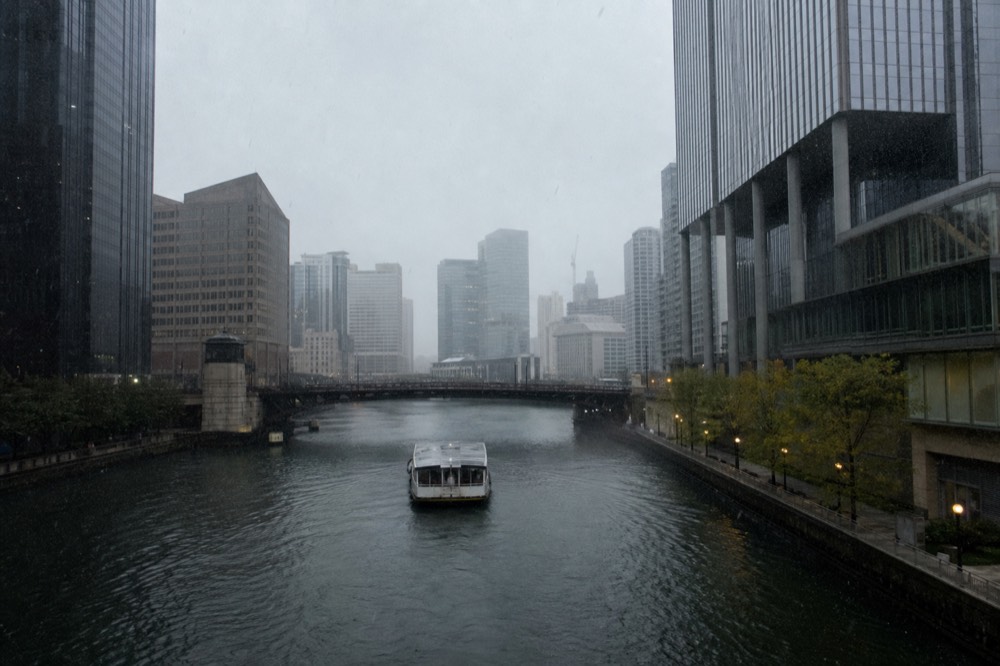
A light rain in Chicago does almost nothing to the river cruise schedule. The boats are built for it, the crews are used to it, and the architecture you came to see is 40 stories tall and completely indifferent to the weather. What actually cancels a cruise is a much shorter list: lightning in the area, sustained high winds, and ice in the river. Everything else, from drizzle to a steady gray sprinkle, generally sails on time.
That surprises people who booked a cruise weeks in advance and wake up to a wet forecast. The instinct is to assume the trip is dead and start replanning the day. In practice, the operator makes the call, usually within a couple of hours of departure, and in most cases the call is to go. Chicago River Cruises tracks how these policies actually work on the water, and the short version is that rain is a comfort question, not a safety question, until it becomes one.
There is also a historical angle that explains why the operators are so relaxed about weather. Wendella Tours and Cruises was founded in 1935 and has run Chicago's first architecture-focused river tour in this climate for the better part of a century, through every kind of gray, wet, and windy day the Midwest can produce. Shoreline Sightseeing has been on the water since 1939. These companies did not survive that long by cancelling every time the sky looked doubtful. Their entire business model assumes the cruise runs.
Do Chicago Boat Tours Run In The Rain?
Yes. Chicago river cruises run in light rain and drizzle as a matter of routine; operators only cancel for lightning, high winds, severe weather warnings, or ice, and most cancellations are decided by the operator shortly before departure, with rebooking or a refund offered if the boat does not sail.
That is the honest, complete answer, and it is worth unpacking because "rain" covers a lot of ground. A misty October morning with fog on the river is one of the best conditions a photographer could ask for, and no operator cancels for it. A thunderstorm cell sitting over the lake is a different situation entirely, and every operator on the river treats it the same way: nobody sails into lightning.
The practical consequence for you as a ticket holder is that you should not preemptively skip your cruise because of a rainy forecast. Show up. The operator has weather radar, Coast Guard advisories, and decades of experience deciding when the river is safe, and they will not send a boat out in genuinely dangerous conditions. If they cancel, you get your money back or a rebooking. If you simply do not show up because it looked wet outside, you usually get nothing.
It also helps to understand what the boats themselves are like. Most Chicago river cruise vessels are open-air but designed with substantial covered sections, canopies, and indoor seating, so a shower during the cruise means shifting your chair, not ending the trip. The Chicago Architecture Center's cruise aboard Chicago's First Lady, for instance, runs a docent-led format that has operated since 1983 in a city that averages plenty of gray days. The show goes on.
A useful mental model is to separate the two things a cruise delivers: the narration and the view. Rain barely touches the narration, since your guide is on a microphone and the buildings are discussed whether or not you can see them crisply. It only partially touches the view, and often improves it. Once you frame it that way, a wet forecast stops looking like a cancellation risk and starts looking like a tradeoff you can plan around.
When Do Chicago Boat Tours Actually Get Cancelled?
Cruises get cancelled for lightning in the area, sustained high winds, active severe weather warnings, and ice on the river in winter; light to moderate rain alone almost never cancels a Chicago cruise, and the decision is made by the operator, not by you.
Lightning is the hard stop. When there is electrical activity in the forecast area, boats stay at the dock until the cell passes, and if the window does not clear before the scheduled departure, the cruise is scrubbed. Wind is the other big one. The river downtown behaves like a canyon, and strong sustained gusts can make docking genuinely difficult, so wind cancellations happen even on days without a drop of rain.
Ice is the seasonal version of the same logic. The 2026 Chicago Architecture Center and First Lady cruise season runs March 15 through November 22, and operations throughout the season are weather- and ice-dependent, as they are for every operator on the river. Wendella is the outlier, running year-round except Christmas Day, but even Wendella's boats are subject to ice conditions in the dead of winter. Lake access depends on the operating schedule, weather and current lock notices; there is no standing mid-November-to-mid-April closure that automatically turns every lake cruise into a river-only trip.
One more thing worth knowing: fog. Dense fog does not usually cancel a cruise outright, but it can change the experience. A foggy river is atmospheric and moody, and the buildings disappear into the clouds in a way that photographs beautifully, but you will not see the skyline from a distance. Some people consider that a downgrade. Others book fog on purpose.
Timing matters in the cancellation decision too. A storm cell forecast for 4 p.m. does not necessarily kill a 1 p.m. departure, and operators know their routes and turnaround times well enough to make those calls hour by hour. This is why the cancellation decision often comes late, sometimes 30 to 60 minutes before boarding, and why hanging around the dock area with a coffee is a reasonable way to spend a questionable afternoon. If the weather is moving fast, ask the dock crew directly. They would rather tell you the honest status than watch you walk away frustrated.
If your forecast is uncertain and you are deciding whether to lock in a departure now or wait, the skip-the-ticket-line architecture cruise is the safest kind of booking to make, since you are not gambling on a same-day ticket window in the rain:
What Is It Actually Like On The Boat When It Rains?
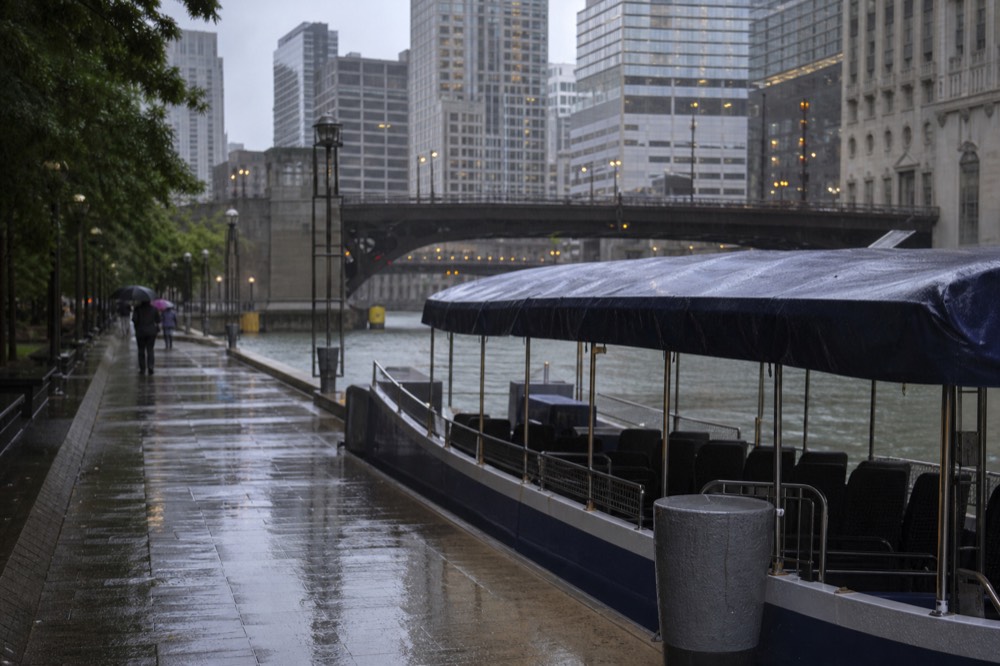
On a rainy cruise you sit under the canopy or in the covered section, the commentary continues as normal, the buildings look sharper against a gray sky, and the crowd is noticeably smaller, so the experience is rarely worse and sometimes better than a sunny departure.
The first thing that happens when rain starts mid-cruise is a mild reshuffling of seats. The open bow clears out and everyone moves aft, under the roof. On a full sunny departure this can feel cramped. On a rainy day the boat is rarely full, so there is usually plenty of covered space to go around. Bring a rain jacket rather than an umbrella, since an umbrella on a moving boat is mostly a hazard for the person behind you, and a hood or cap does the same job with none of the fuss.
The commentary does not stop. Your guide or docent keeps narrating whether the sun is out or not, and honestly, the narration is the core product on an architecture cruise. The Chicago Architecture Center's cruise covers more than 50 buildings along the river in about 90 minutes, narrated by CAC-trained volunteer docents rather than standard crew commentary, and none of that depends on the weather being pretty. The buildings named and discussed on that cruise include Willis Tower, the Wrigley Building, Tribune Tower, Merchandise Mart, the Lyric Opera building, 333 West Wacker, and Marina City, and every one of them is still standing in the rain.
Photographers have a specific reason to like rain. Wet air cleans haze out of the sky, clouds diffuse the light evenly across the building facades, and wet streets and river surfaces pick up reflections that sunny days do not give you. If you have ever struggled with harsh shadows and blown-out skies in your Chicago skyline shots, an overcast departure solves both problems at once. The glass towers in particular photograph beautifully under a flat gray sky.
The one genuine downside is the lake. On combined lake and river routes, the lake portion can be choppy and cold in wet weather, and spray over the bow is a real thing on the open water stretch. If you run into rain and get seasick easily, a river-only architecture cruise is a calmer ride than a lake and river combination, because the downtown river is narrow and sheltered by the buildings on both banks.
Kids, for what it is worth, tend to love a rainy cruise. There is something about being under a canopy on a moving boat in weather that reads as adventure rather than inconvenience to anyone under about ten years old. If you are weighing whether a wet departure works for a family, our piece on kid-friendly Chicago river cruises covers the family angle in more depth, and the short version is that rain changes the logistics, not the appeal.
Which Chicago Cruises Have The Best Rain Protection?
The best rain protection comes from Wendella's large covered vessels and First Lady's canopied fleet for open-air cruises, and from Odyssey Chicago River's glass-enclosed boat for full weatherproofing, since it was launched in 2018 as the city's first year-round, glass-enclosed dinner cruise on the river.
For a standard sightseeing or architecture cruise, you are on an open-air boat with a canopy, and that is fine. The vessels run in this climate for eight or nine months a year, and the covered sections are designed for exactly this scenario. Shoreline Sightseeing, which carries just over 1 million passengers per year on average, runs its architecture tours from the Michigan Avenue Riverwalk near the Apple Store and from Navy Pier, and its boats handle routine rain without disruption.
| Operator | Boat type in rain | Rain experience | Notes |
|---|---|---|---|
| Shoreline Sightseeing | Open-air with covered seating | Move under the canopy, commentary continues | Architecture tours added in 1999; runs from Riverwalk and Navy Pier |
| Wendella | Large vessel, substantial covered sections | Comfortable in steady rain | Founded 1935; runs year-round except Christmas Day |
| Chicago's First Lady (CAC cruise) | Canopied fleet, docent-led | Covered seating, full narration | Official CAC operating partner since 1993 |
| Odyssey Chicago River | Glass-enclosed dinner cruise | Fully weatherproof, indoor dining | Year-round since 2018; docks near NBC Tower |
The CAC/First Lady docent cruise runs its roughly 1.5-hour route under that canopied setup, rain or shine, so a wet forecast does not change the narration, only the seat you pick.
The glass-enclosed option deserves a mention because it changes the calculus entirely. If you are planning a special-occasion dinner and the forecast looks ugly, Odyssey Chicago River removes weather from the equation altogether. For the classic architecture cruise experience, the canopied boats are the standard, and they are perfectly pleasant in rain as long as you dressed for it.
Boarding location matters in rain more than people expect. The Shoreline docks at Michigan Avenue on the Riverwalk and at Navy Pier, the Wendella dock sits at 400 N. Michigan Avenue at the base of the Wrigley Building, and the CAC and First Lady cruise boards at 112 E. Wacker Drive near Tribune Tower. All of these are short walks from covered areas, but if you are arriving by rideshare in a downpour, plan the drop-off point so you are not standing in the open with tickets in hand. Wet docks add an extra wrinkle if you use a wheelchair or need boarding assistance; our guide to wheelchair-accessible river cruises covers what to expect at each one.
For the standard architecture cruise in changeable weather, the Shoreline departure is the one we would keep on the calendar without hesitation:
You can check availability for a specific date on the operator's live listing before you commit, since departure frequency varies with season and demand.
Is A Rainy-Day Cruise Actually Better?
Often, yes. Rainy departures draw smaller crowds, the air is clearer for photography, the river is quieter, and ticket availability opens up on sailings that would sell out on a sunny Saturday, so a gray forecast can work in your favor.
Summer Saturdays on the Chicago River in full sun are a scene. The boats are packed, the Riverwalk is packed, the docks are packed, and the ticket lines are long. A departure under a gray sky with a 40 percent chance of drizzle is a completely different animal. You get your pick of seats, more room under the canopy, and a docent or guide who can actually take questions instead of narrating over a full deck.
Availability matters too. The most popular Chicago architecture cruises carry badges like "likely to sell out" on their listings, and they earn them on good-weather weekends. A rainy forecast is the single most reliable thing that empties those boats. If you missed out on a sunny departure, a wet afternoon is often your way in, sometimes at the same price with none of the crowd.
There is also a case that the architecture itself looks better. Chicago's skyline was built for drama, and drama is what a brooding gray sky delivers. The dark glass of 333 West Wacker against storm clouds, or Marina City's corncob towers disappearing upward into fog, is a more cinematic image than the same buildings under flat blue. Local photographers know this. If you see a cluster of tripods on the Riverwalk bridge on a gray day, they are not there by accident.
The honest caveat: rain that turns heavy and sustained, with wind behind it, is just unpleasant, covered section or not. You will still see everything and hear everything, but you will remember the wet socks. That is a wardrobe problem, not a booking problem, and the next section handles it.
What Should You Wear And Bring For A Rainy Cruise?
Wear a waterproof jacket with a hood, closed-toe shoes with decent grip, and a warm layer underneath, and bring nothing you would be upset to get damp; skip umbrellas, since a hood does the job on a moving boat without blocking anyone's view.
The deck of a river cruise boat can be slick in rain, and you will likely move around to see buildings on both sides. Shoes that grip matter more than shoes that look good. In spring and fall, add a warm layer, because rain in Chicago usually arrives with a temperature drop, and the wind between the towers on the main branch can cut through a cotton hoodie fast. The lake portion of a combined route is colder than the river portion, so if your cruise heads out to the lakefront, plan for it.
For a fuller packing rundown that covers sun, wind, and cold as well as rain, our what to wear on a Chicago river cruise guide goes into detail. The short version for a wet day: rain jacket, cap or hood, grippy shoes, phone in a zip pocket or dry bag, and a small towel in your bag for glasses and camera lenses.
Phone photography in rain is its own small skill. Keep the lens wiped, shoot through the canopy framing when you can, and remember that reflections on the water are a feature. A lens cloth is the single most useful two-dollar item you can bring on a rainy cruise.
One last practical note: give yourself a few extra minutes at the dock. Wet boarding areas mean slower lines, and if you are sprinting from a rideshare with a hood up and a phone in your teeth, you will start the cruise stressed instead of settled. Arrive early, get under the canopy, and let the rain be someone else's problem.
Common Questions About Chicago Boat Tours In The Rain
Follow the operator’s departure updates and the cancellation terms attached to your ticket. Contact the operator if travel to the dock is affected by severe weather.
Do Chicago boat tours run in the rain?
Yes. Light rain and drizzle almost never cancel a Chicago river cruise. Operators cancel for lightning, sustained high winds, severe weather warnings, or ice, and the decision is made by the operator close to departure time. If they cancel, you are offered a rebooking or refund.
Will I get a refund if my cruise is cancelled for weather?
Weather cancellations are initiated by the operator, not by you, so you are not treated as a no-show. Operators offer rebooking or a refund when they cancel a departure. Check the cancellation terms on the operator's live listing when you book so you know the process in advance.
Should I cancel my cruise if rain is in the forecast?
No. If you skip the departure on your own, you are generally treated as a no-show and lose the ticket. If you show up and the operator decides conditions are unsafe, you are covered. Let the operator make the weather call, not the forecast app.
Are the boats covered when it rains?
Most Chicago river cruise vessels have substantial covered sections and canopies, so rain means moving to covered seating, not ending the tour. For full weatherproofing, Odyssey Chicago River runs a glass-enclosed dinner cruise year-round.
Is a rainy cruise worth it compared to a sunny one?
Usually, yes. Rainy departures have smaller crowds, better ticket availability, and cleaner air for photography, and the commentary and buildings are the same either way. The tradeoff is comfort, which a rain jacket and grippy shoes largely solve.
Does rain affect lake and river cruises differently?
Yes. The downtown river is narrow and sheltered by buildings, so it stays calm in rain. The lake portion can be choppy and cold in wet weather, with spray over the bow. If you are prone to seasickness on a gray day, a river-only architecture cruise is the calmer choice.
Follow the operator’s departure updates and the cancellation terms attached to your ticket. Contact the operator if travel to the dock is affected by severe weather. Bring the rain jacket. Leave the umbrella at the hotel. And if the forecast is clear instead, check whether your dates line up with Navy Pier's real summer fireworks schedule before you plan the evening. Navy Pier's real summer fireworks schedule
Choose Your Chicago Cruise Date
Initial editorial recommendation. Change the options below to narrow the shortlist.
Wendella 90-Minute Architecture Cruise
Have a travel date in mind? Live architecture commentary through all three branches, with an enclosed lounge. Check the departure before arranging the rest of your day.
Arrive 30 minutes early; travel to the dock is additional. Indoor and outdoor seating. Food and drinks cost extra. Confirm the terms for your chosen departure.
Select a date to inspect Viator’s scheduled departures. Seats and final price are confirmed on Viator.
Schedule only, not confirmed availability. The booking link works even if schedules cannot load.
Compare Options And Fit This To Your Day
Add travel to and from the dock separately. Lake traffic can extend timings; a flight or tight connection needs a larger buffer.
Choices narrow the reviewed shortlist; they do not confirm eligibility, a seat or a departure. Check the exact ticket restrictions before paying.
Wendella 90-Minute Architecture Cruise: Live architecture commentary through all three branches, with an enclosed lounge. Arrive 30 minutes early; travel to the dock is additional. Indoor and outdoor seating. Food and drinks cost extra. Confirm the terms for your chosen departure.
Wendella 45-Minute Architecture Cruise: A shorter narrated trip along the main river and part of the South Branch. Arrive 30 minutes early; travel to the dock is additional. Indoor and outdoor seating. Food and drinks cost extra. Confirm the terms for your chosen departure.
Wendella Lake And River Cruise: Combine close-up river architecture with the skyline from Lake Michigan. Arrive 30 minutes early; travel to the dock is additional. Indoor and outdoor seating. Food and drinks cost extra. Confirm the terms for your chosen departure.
Compare Two Party Quotes
Enter the final total for your whole party in the same currency, including required fees. Add optional drinks, transport and a separate meal consistently.